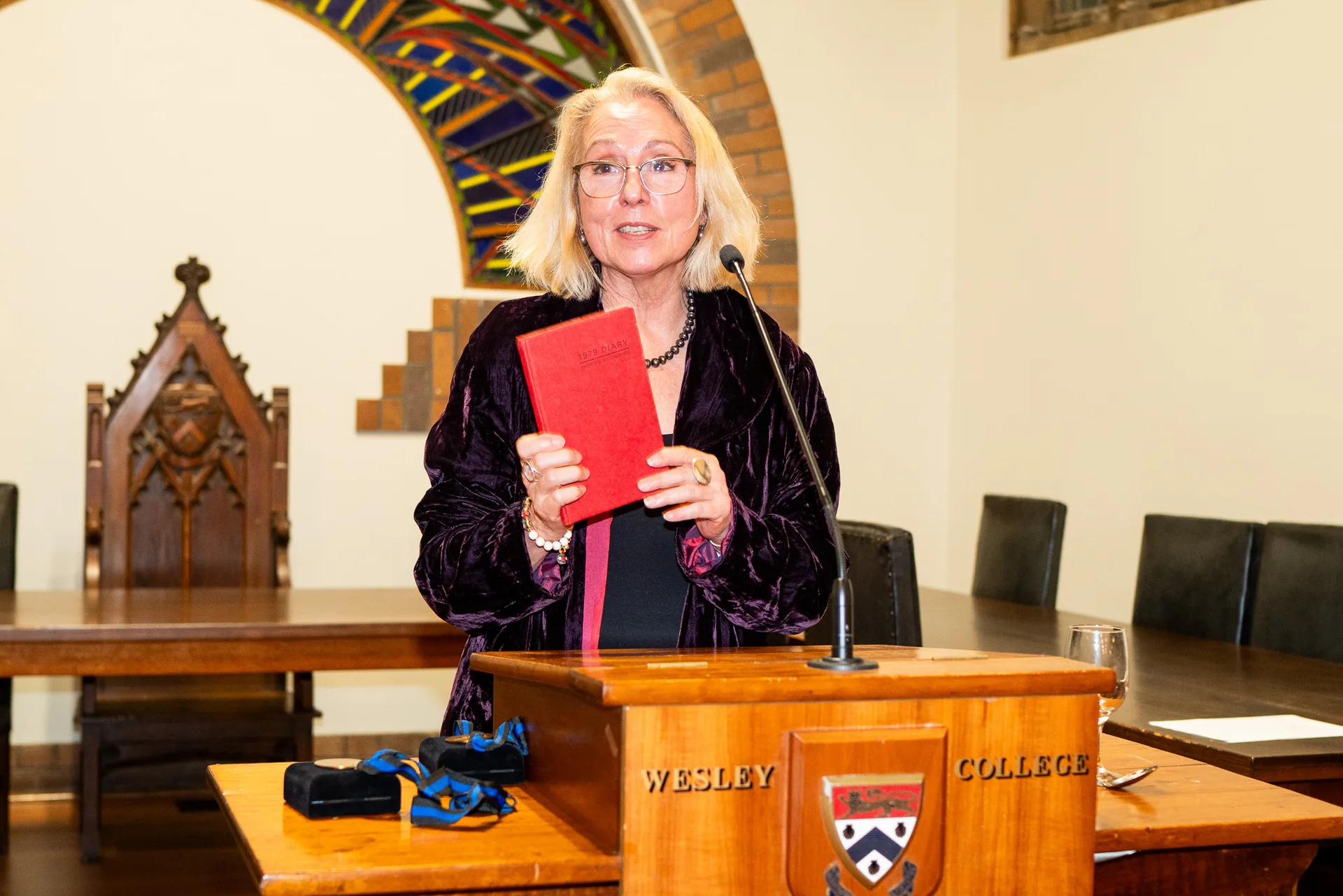
Margot Saville (fr 79) awarded the 2025 Foundation Medal
Margot Saville discovered the real mission of journalism when she came across the case of an indigenous woman, Robyn Kina, who had been subjected to years of horrific domestic violence. Fighting back, Robyn had accidentally killed her de-facto husband. She had gone on trial for murder, but no evidence of the domestic violence had come out at the trial, and she had been sentenced to life imprisonment with hard labour. Working for Four Corners, Margot brought out the background of the case and in the resulting public outcry brought about both a change in the law and the release of the woman. The woman then made her contribution by working with other female prisoners. The story justifiably won awards and one must surely ask: how much worse off would society be without such journalistic commitment?
Margot is a proud product of Wesley. Born in Papua New Guinea, growing up on an agricultural college “along with pigs, cows, horses and poultry” – and crocodiles which her father had decided to breed – she went to school in Toowoomba, Queensland, went to Sydney University and entered Wesley. “I lived in a room in Lower Callaghan and threw myself into college life, studying Japanese and politics and tried to attend as many end-of-term parties at Manning Bar as possible, confidently telling my mates that this new band at the Bar - INXS - showed some promise,” Margot said. “I’m probably one of the few people to go through college without playing a single sport.”
Margot graduated in Arts and Law, travelled to Japan and Europe for a year and started as a solicitor with the firm, Allen Allen and Hemsley. But she was drawn to journalism and applied for a cadetship with The Australian. Successful, she was put onto the business pages and had to deal with the global share market crash of 1987. “I received a crash course in market economics and how to file a breaking story in the days before mobile phones,” she said. Four years later, Margot joined the ABC to work on Four Corners. She then moved to Channel Nine and worked on the Sunday program for two years, after which she joined the Sydney Morning Herald and worked on its business pages. She was in time for the transition to the digital era, which had profound implications for the industry. She also renewed her contact with Wesley, wrote articles for The Wesleyan, mentored students during a writing project on the Women of Wesley in 2019 and in 2007 joined the Wesley College Foundation.
During this very busy life, with two children to look after, she decided to go freelance and filed stories [AB5] for Crikey while writing a few books at the same time - one of which was about Maxine McKew, The Battle for Bennelong: The Adventures of Maxine McKew, and another one about the “teal” political phenomenon, The Teal Revolution, an insider’s view of the extraordinary 2022 election campaign in Wentworth and other key Teal seats. After a break, Margot returned to the Wesley Foundation in 2022, as the chair of the Old Cols Association. She has since stepped down because of work pressures but is open to coming back at some future time. “Now that my children are much older, I’ve returned to full time work and am currently one of the Deputy Opinion Editors at the Sydney Morning Herald,” she said. She is open to opinions, she says, and loves to talk to “young people with strong opinions”.