ROBERT PARKER (fr 64)
Loved Wesley, Went On To Stride The International Scene
From the very outset of his student days in Texas, Robert (Rob) Parker showed he was more than just a student. Born in Longview, Texas, son of a newspaper editor Rob was a high school newspaper editor, actor and championship orator. He delivered papers as a boy to pay for flying lessons. After high school, he declined a drama scholarship and a place at the US Air Force Academy and opted for an Arts course at the University of Texas, Austin. As a university student, he was so knowledgeable and articulate that the University of Texas’ Communications Department hired him while in law school to teach a sophomore-level course on public speaking. Midway through 1963,the Rotary Club of Longview, Texas, nominated him for a Rotary International Scholarship which allowed for a year’s study overseas. He took it up.
Rob spent 1964 at the University of Sydney, where he studied international relations and resided at Wesley College. He was destined through his interest in international relations to go into the stratosphere, becoming an international figure and a significant influence on the United States Government.

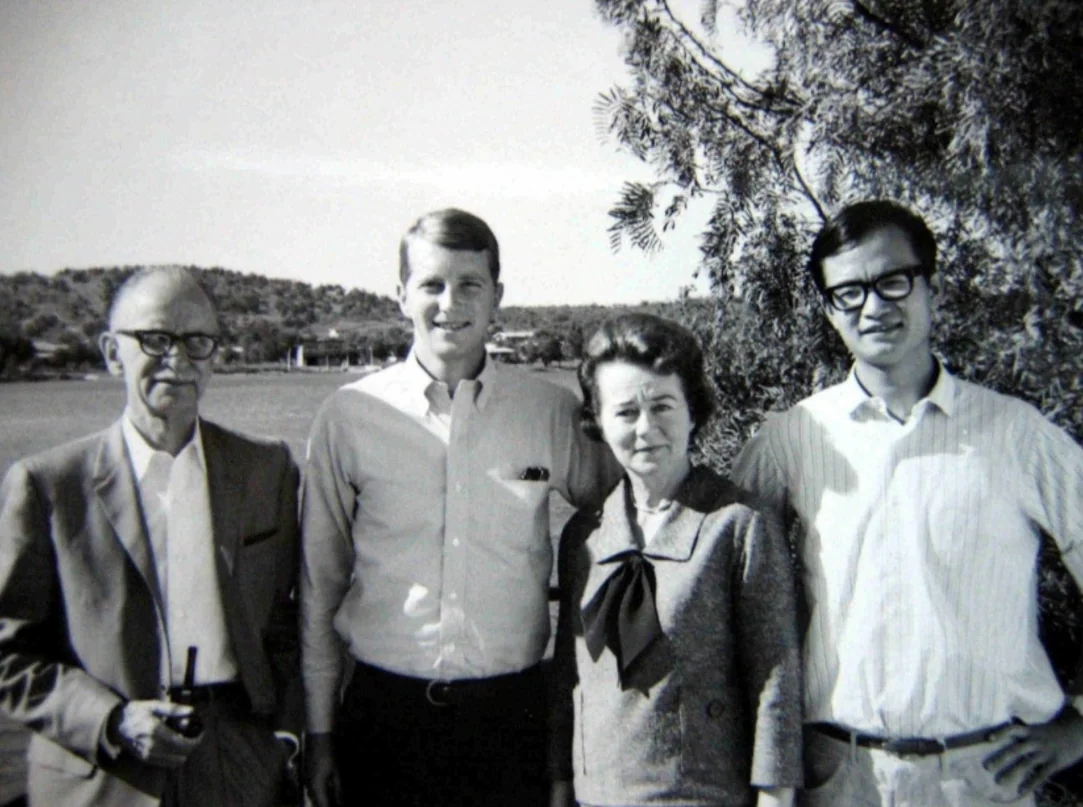
While Rob was at Wesley, he was invited to speak at various Sydney-area Rotary clubs, where he was warmly received. His name spread and he received invitations to speak at other Rotary clubs throughout Australia. He also wrote articles for his hometown newspaper, The Longview News-Journal. He enjoyed Wesley. “The friends I made there were medical students and law students, and all were Aussies, with a few exceptions such as Ed Cheng, a likeable med student who became my closest friend at Wesley,” Rob said. “Ed was tall and good-looking and from a wealthy Chinese family in Hong Kong. He was one of the very few students at ‘Uni’ who could afford a car, and Ed’s was a shiny new MG sportscar. Other Wesley collegians who became my good friends were Ian Carroll, a law student, Peter Reddell, a fellow pilot, and several medical or veterinary students including Leslie Glen, Paul Wansey, and Allen Calvert.”
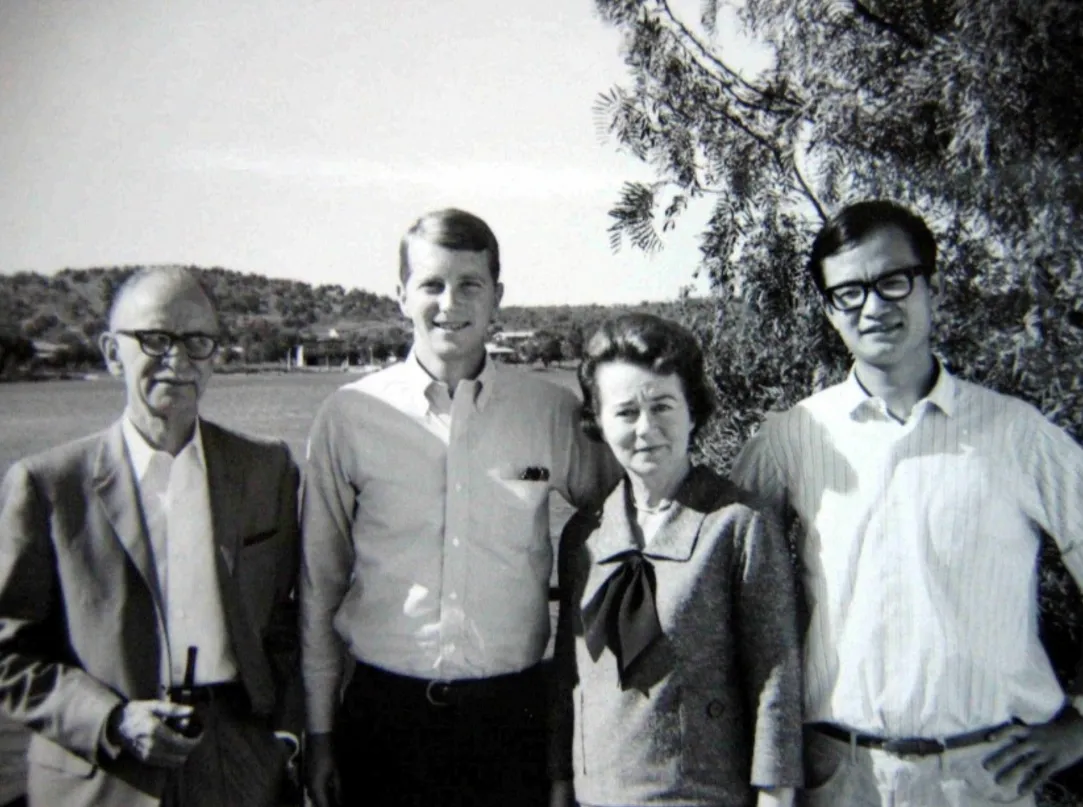
The medical students looked after Rob, and arranged for him to eat at the PA Club, affiliated with Prince Alfred Hospital, as a "visiting American medical student". “The best part of meal times at Wesley was the fellowship with other students in the dining hall, as well as the academic robe-wearing pageantry of twice-weekly formal dinners,” he said. He met a “beautiful student nurse”, Glennis Woods, whom he would marry in Texas in 1966 and with whom he would have a son, Phillip, and daughter, Christina.
Rob’s fame spread so widely that the US Consul-General, Edward Andrew Bolster, and Milton Chase, Director of the US Information Service in Australia, invited him to lunch and asked whether he would be willing to render an unpaid service for his country. “I would be rendering a great service if I could accept some of their speaking requests, they said. I wouldn't be authorised to speak about US Government policy, but many of the requests concerned things like how America’s political system works, the private sector's role in foreign relations, and educational and cultural subjects. I said that I would be happy to do it whenever possible, and they promised to find a way to show their appreciation. I happily added giving speeches as a private citizen on behalf of the US Government to my schedule of activities in Australia.
“Those speeches for the US Government led to a fascinating meeting with the Prime Minister of Australia, Sir Robert Menzies. Thanks to a series of talks that I gave to chapters of the Liberal Party's youth organization, I met and became friends with Sir John Carrick, General Secretary of the Liberal Party and later Minister of Education in the Federal Government. Sir John seemed to enjoy chatting with me about international affairs, since my perspective differed from the local views he heard every day. He also liked telling me his opinion of the American politicians he had met on their boondoggles to Australia. Sir John particularly disliked Richard Nixon, and told me how fortunate we were that ‘Tricky Dick’ had never become president, which of course Nixon did.”
Rob travelled throughout Australia and New Zealand and also took time to pursue his passion for flying. “Flying light airplanes was expensive, more so than at home, so finding ways to fly in Australia wasn't easy on a student budget, especially in the absence of a part-time job,” he said. “Fortunately, I was able to find opportunities through the generosity of friends in Rotary and at Wesley College. Peter Reddell was a reserve officer in the Royal Australian Air Force. I flew with Peter in an RAAF Chipmunk, a very capable airplane designed for training fighter pilots during and after WWII. On speaking trips to smaller towns, local pilots, usually Rotarians, gave me opportunities to fly other interesting airplanes.”

Rob also travelled to Asia and spoke to Rotary clubs in Singapore and Saigon. “In Hong Kong, my Wesley College friend Ed Cheng's older sister Addie met me at the airport, and Ed's family insisted that I be a guest in their Kowloon mansion, ”Rob said. “The Chengs' residence was home to three generations of the family. The senior family member was Ed’s grandmother, who at age 91 remembered more about the old days in Shanghai than the modern world of Hong Kong. In Taipei, Rob was a guest of Taiwan's Government Information Office, which arranged interviews for him with various government officials and academic experts, plus a long interview with GIO Director-General James Wei. Rob became intimately acquainted with the history of the struggle between the Nationalists and the Communists. “My ROC [Republic of China] Army hosts also showed me a sample of anti-KMT and anti-American propaganda from the Communist side, lofted over by balloon,” Rob said. “Most of it was too blatantly obvious to influence anyone, but a printed flyer showing Alabama police dogs snarling at black people demonstrating for civil rights made me acutely uncomfortable. ‘This isn’t real, is it?’ my hosts inquired.” Rob warmed towards the Chinese people, whom he found “impossible to know and not like”. By the time he arrived in San Francisco on his return to America, “I knew that I wanted to devote my future career to Asia”.
Rob married Glennis in Texas in 1966 and resumed his studies for a Law degree. Ed Cheng, who had finished his medical degree and was to do his residency in Canada, looked him up in America. Rob visited Ed in Toronto and Vancouver, before Ed went to Hong Kong, and he was saddened when Ed contracted Parkinson’s Disease, from which Ed would die. In the meantime, Rob met some real heavyweights, including former Secretary of State Dean Acheson and Martin Luther King. Through Acheson, he developed a keen interest in international law. He led a team from the University of Texas’ Law School to national victory in moot competition, beating Yale University. Graduating with Honors and sporting the title of “Doctor of Jurisprudence with Honors”, he headed for Washington DC.
Rob went on to practice international law in Washington, San Francisco and Taipei for four decades. He also established two successful venture capital firms in Silicon Valley. He served on the national campaign staffs of President Lyndon Johnson and Vice President Hubert Humphrey. He was chairman-elect of the Taipei Chamber of Commerce (later AmCham Taiwan) when US President Jimmy Carter announced that America would end formal diplomatic relations with Taiwan and recognise only the People’s Republic of China. At that moment, in December 1978, Taiwan was left isolated. The US Embassy in Taipei was due to close and the US-Taiwan mutual defence treaty was to lapse. No plans were in place for what kind of unofficial US-Taiwan relations would follow. Parker mobilised AmCham to step into the vacuum, and went to Washington to give advice and to assure Taiwan’s security and preserve strong bilateral economic and cultural relations.

Parker’s testimony before the US Senate Foreign Relations Committee helped shape the Taiwan Relations Act. This was passed by the US Congress in 1979 to authorise the “continuation of commercial, cultural, and other relations between the people of the United States and the people on Taiwan”. It still forms the legal basis of US relations with Taiwan. The Chamber also negotiated with the Taiwanese government to enable continued operations for the American Club and Taiwan American School, as well as conversion of the US military radio station into a private operation with special permission to broadcast in English. Sadly, Rob’s marriage to Glennis broke down and the couple divorced. In 1989, he married a Taiwanese law graduate, Yachien, with whom he had a daughter, Adrienne. In May 2000, he was awarded Taiwan’s highest civilian honour, Order of the Brilliant Star, for his contributions to US-Taiwan relations.
Rob retired in 2015and settled in California but kept close contacts with Taiwan, serving on numerous boards and educational organisations there and as a trustee of the China Foundation for Promotion of Education and Culture. He also never lost interest in Australia. “Australia won my heart during the year at Wesley College,” he said. “I have returned to Australia scores of times. I hope there will be more ahead, since my eldest daughter, son-in-law and all three of my grandchildren now live in Adelaide.”
Rob organised and implemented a Rotary project in 2017 to install solar-powered lighting in a Haitian village. Flying his own airplane, he also acted as mission command pilot and advocate for two aviation-related charities, Angel Flight and Wings of Faith. He wrote a book pleading for Taiwan at a time of international tension and the continuing threat of communist China’s threat to take thecountry over. The book, in collaboration with Don Shapiro of AmCham Taiwan, is Derecognition: How Americans in Taiwan surmounted multiple crises and helped shape the Taiwan Relations Act when the U.S. broke diplomatic relations with a loyal ally.
.webp)
.webp)